
Complaining is a disease

Complaining is a disease, a contagious, addictive one, to be precise. It’s easy, it’s cheap, you don’t even need a dealer, and it triggers your brain in exactly the same way as any other addiction.
Honor to whom honor is due. The image shows the Western Wall, popularly known as the ‘Wailing Wall’. Read a fine article about this wall by journalist Alfred Muller here: “click”
Foreword
This post was born at a birthday party. A party where people complained about the high healthcare costs, energy bills, fines and taxes in the Netherlands — the list is endless. Not fifteen minutes later, the conversation turned to frustrations at work: ‘Just call in sick with a migraine, they can’t verify that anyway…’
I have to bite my tongue and swallow it, because otherwise a discussion erupts that could well end in us not seeing each other for months — or even years. Because in these circles, the rule is simple: if you’re not with us, you’re against us.
Then, envious as they are, they started tearing into the idea of owning two cars. ‘It’s nonsense! And it’s why nobody can park anymore.’ Well, apparently the fact that I spend two hours a day driving to work, and my wife well over an hour, is also nonsense: ‘Just find something closer to home… I wouldn’t even want two cars.’
And I think to myself: yes, you would. But you can’t afford it, because you keep standing in the way of your own career by calling in sick with a migraine at the slightest bit of resistance.”
Of course, it’s stupidity at its finest. But then again, you don’t get to pick your family
or so we tell ourselves…
The reason this one hits me particularly hard is that I’ve lost friends to illness, cardiovascular and lifestyle diseases, cancer, despair and depression, and that I myself, and my children too, have needed a doctor a little too often for my liking to make life pleasant and livable again.
So in our home, faking an illness to get out of something sits on the same list as something as base as theft, because that’s exactly what it is. You should never tempt fate with illness. And beyond that, it’s stealing from the collective insurance pot (which is precisely why premiums are so high, though nobody stops to think about that). Because if you didn’t get paid a cent for your first ten days of sick leave, you’d show up to work with a mild fever just like everyone else…
Complainers
- Attention-seekers: they keep droning on about how much worse off they are than everyone else.
- Chronic complainers: even when they don’t voice their lament out loud, they’re most likely still thinking it.
- Low-EQ complainers: these people lack emotional intelligence. They have no interest in your perspective, thoughts or feelings. To them, you’re merely a sounding board.
From personal observation, I’ve found that many so-called complainers tend to be couch-sitters: they live on benefits and are dissatisfied with their situation — their income, paying too much tax — and indulge heavily in us-versus-them thinking. Meanwhile, the non-complainers take the pain, push through, and with their contribution to the tax pot fund the very benefits of those complainers. Who, in turn, react with envy to the ‘success’ of the non-complainers, ‘look at them… two cars in the driveway now!’ instead of thanking them for the stay-at-home facility that was created on their behalf.
Now, I’m no psychologist or neuroscientist, but I believe this comes down to a misalignment: not being able to spend your days doing something you enjoy and that gives you a sense of purpose. Either you go to work merely to drop off your shoes and be present in exchange for a payslip, or you go to work with pleasure because you get to do something you enjoy — something useful, serving a cause you yourself find important.
I teach my children that it’s better to do something you love than to desperately try to be successful at something you want to be, but aren’t, or can’t. As far as I’m concerned, any profession is a good one, but I do expect you to want to be the best at it. And that’s not even that hard, precisely because you love what you do.
I also tell them: if you’re highly successful and pursue it, you can even become a millionaire. A hairdresser, plumber, carpenter or electrician has just as much potential to achieve financial wealth and independence. In fact, I’m convinced that when you do what you love, you’re far less likely to end up in a culture of complaint.
Complainers have too much time on their hands…
What strikes me is that many complainers generally have a lot of time. Take the news, for instance: people demonstrating (which is really just collective complaining at scale) against, say, the arrival of a new asylum seekers’ centre. And I think to myself: ‘Did you really take a day off for this? Does such a centre so unimaginably violate your heart and sense of justice? Or were you home anyway, with time to spare — venting your personal frustration, most likely born of your own idle behavior and the poor choices you make every day, at a group of people who actually have something to complain about?’ So yes, I have opinions about that.
Put differently: of all the causes one could possibly demonstrate for, I cannot imagine choosing this one — or, if you had a job, that this would actually be worth a day’s wages to you. You simply want to shift the blame for not taking your own daily responsibility onto someone else… (while sitting at home on my dime — because I do work, apparently — doing a bit of rabble-rousing…)
One might ask whether people who for extended periods contribute nothing whatsoever to the public purse should be allowed to vote or demonstrate at all. But of course, that goes a step too far for our pampering little land of soft healers…
Complaining is Contagious
Contagion patterns in the workplace and within the family
A culture of complaint doesn’t arise by accident. It spreads through groups via emotional contagion, where one person’s negativity reinforces and amplifies the next’s. In workplaces where venting frustrations has become normalized, cortisol levels across entire teams can remain chronically elevated. A single persistent complainer can shift the emotional baseline of an entire department.
Family dynamics bring unique challenges. Children’s developing brains are particularly sensitive to second-hand stress, as their neural pathways are still forming. When parents or caregivers complain frequently, children adopt these patterns as normal ways of dealing with difficulty. As a result, they may develop a negativity bias of their own before they’re old enough to realize what’s happening.
Why it’s contagious:
- Emotional contagion: brains automatically tune in to the negativity of others.
- Seeking connection: complaining together (co-rumination) feels like a fast way to bond.
- Validation: people often complain not for a solution, but to be heard.
- Peer pressure: when everyone else complains, you join in to belong.”
You could argue that there’s often only one true complainer — ‘Patient Zero’ — and that the rest simply lack the backbone to put things into perspective and push back. My advice to directors and managers: pay attention to this, because in that large group of followers you will not find tomorrow’s leader (team lead, manager).
Protecting your brain when you can’t avoid complainers
You can’t always walk away from chronic complainers, especially when they’re colleagues, family members, or people you truly care about. But you can take steps to protect your own neurological health.
First, learn to recognize when contagion is happening. Notice whether your mood shifts after certain conversations, or whether you feel drained around specific people. This awareness alone can help you maintain some psychological distance.
Second, try steering conversations toward solutions or neutral topics. Complaining often continues because people don’t feel heard — so by briefly acknowledging their frustration before shifting the focus, you can satisfy their need for validation without dwelling on their problem at length.
Third, maintain a balanced social life. Deliberately spend time with people who give you energy and who communicate in a healthy way. Positive interactions can offset the negative effects that unavoidable negative interactions have on your brain.
Finally, practice setting mental boundaries. You can listen with compassion without taking on the other person’s emotional state as your own. This takes practice, but it’s a skill worth developing for the long-term health of your brain.
Don’t complain…
Don’t complain about something you can’t change (wasted energy). And when you can change it, take charge, show leadership — over yourself and over the problem — and don’t complain either. If you do neither, you’re just a lazy whiner… a couch-sitter.
It works roughly like this…
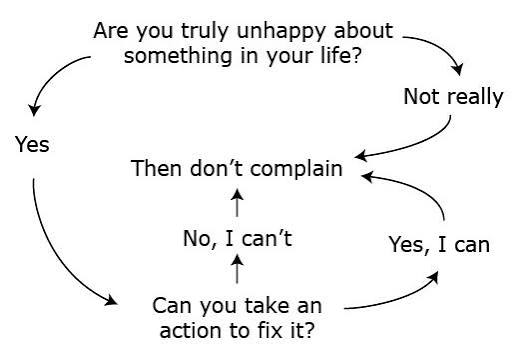
Complaining about a problem without suggesting a solution is called “whining”
Teddy Rooseveldt
What complaining does to your brain…
- Dopamine and repetition: the moment you complain, you unconsciously get a small sense of relief or social connection (like-minded people agreeing with you). This triggers the release of dopamine, the brain’s reward chemical. Your brain wants to repeat that pleasant moment.
- Strengthening synaptic connections: neurons that fire together, wire together. The more often you complain, the more easily your brain takes the ‘complaint highway’ instead of a constructive route. Over time, negativity becomes your default setting.
- Shrinking of the hippocampus: prolonged exposure to stress and negativity increases cortisol production. This inhibits the function and growth of the hippocampus, the brain region crucial for problem-solving and memory.
- Reinforcement of the amygdala: the almond-shaped nucleus (your brain’s fear and emotion engine) becomes overactive through repeated complaining. As a result, you spot dangers, threats and problems around you more quickly — leaving you focused on the negative instead of the positive.
The long-term consequences
- Harder to keep perspective: your rational brain (the prefrontal cortex) gets used less and less as the emotional and stress response takes over.
- A social vicious circle: because your brain becomes accustomed to complaining as social glue, you increasingly attract people who join in the negativity — which reinforces the addiction.”
The Package Insert
What I’ve written above is a personal view, an opinion, but it’s certainly not just nonsense.
And this is why…
Sources: